Isle of Harris

Outer Hebrides · Scotland

The Purpose of This Page

My first name, Harris, comes from the Isle of Harris in the Outer Hebrides of Scotland. The name itself is believed to have Norse origins, likely meaning "high land," a reference to the island's elevated and rugged terrain. Norse settlers arrived in the 9th century, layering their influence over an already established Gaelic culture that had existed in the region for centuries. That blend of Norse and Gaelic history still defines the islands today.

Lewis and Harris are technically one landmass, often referred to as "The Long Island," but they have long been understood as culturally distinct. They are sometimes called the Brother Isles. Harris is known for its rocky mountains, dramatic coastline, and sharp elevation changes. Lewis, by contrast, is flatter, with rolling hills and open fields. In a way, I think the isles character reflects Lewis and myself in a fitting manner.

My mother, who is of Scottish descent, chose the name as a way of carrying that heritage forward. For most of my life, it was simply the name I answered to. Over time, I became more curious about the place behind it. The more I read, the more I realized that it is not just a landscape but a history shaped by language, craftsmanship, clan structure, migration, and survival.

This page is my attempt to understand and share that history more clearly. It is a way of documenting the research behind the name I carry and recognizing that it connects me to something much older than myself.

The Third British Isle

Lewis and Harris is the largest island in Scotland and the third largest in the British Isles, after Great Britain and Ireland. Despite its name suggesting two separate places, it is a single island, split by tradition and terrain rather than water. The northern two-thirds is Lewis, flat and boggy. The southern third is Harris, mountainous and wild. The boundary between them runs along a chain of hills so rugged it kept two cultures distinct for centuries.

Lying 24 miles off the west coast of the Scottish mainland, separated by the Minch, the island belongs to the Outer Hebrides. It is a place shaped by Atlantic weather, Norse history, and the Gaelic language. Around 60% of islanders still speak Scottish Gaelic daily, one of the highest concentrations anywhere in the world.

841 mi²
Total Area
799m
Clisham Peak
60%
Gaelic Speakers

Land & Sea

Harris is defined by its extremes. The interior is dominated by more than thirty peaks above 1,000 feet, crowned by Clisham at 799 metres, the highest point in the entire Western Isles. The mountains are ancient, formed of Lewisian gneiss, some of the oldest rock on Earth at nearly three billion years old. From their summits, on a clear day, you can see the Uists to the south and the Scottish mainland to the east.

Then the land drops to the coast, and everything changes. The west side of Harris holds some of the most beautiful beaches in Europe. Luskentyre, the most famous, stretches in a wide arc of white shell-sand with water so turquoise it has been compared to the Caribbean. The sands are composed of finely ground shells and quartz, and the colours shift constantly with the tide and the light.
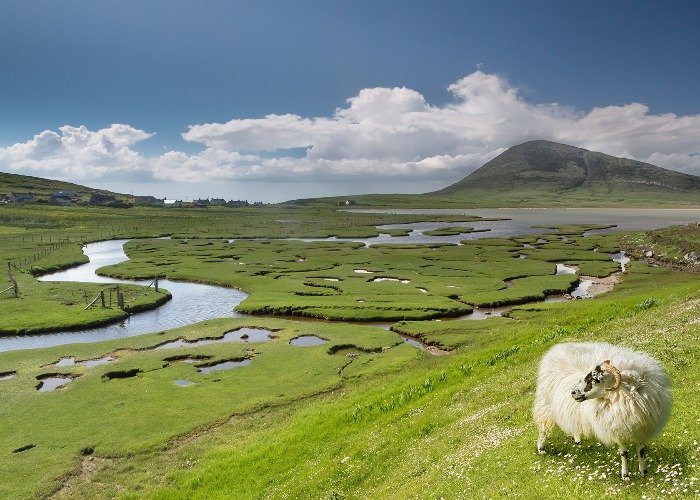
Harris mountains and landscape

The east coast is the opposite. Rocky, indented, scattered with tiny settlements and single-track roads that wind through moonscape terrain. The contrast between the two sides, barely a few miles apart, is one of the most striking things about the island. It's a place where the landscape changes completely in the time it takes to drive ten minutes.
Harris Tweed

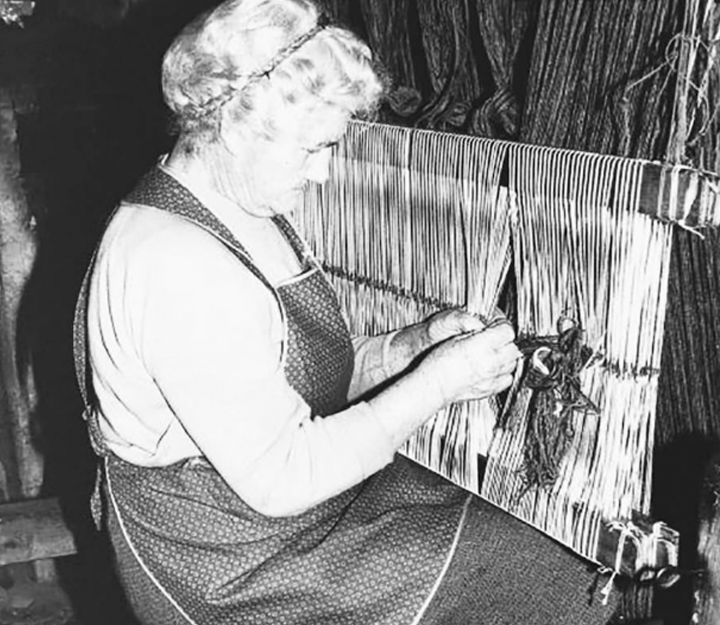
One of the most well known exports of the Isle of Harris is Harris Tweed. What makes it unique is not just the look or the pattern, but the legal protection behind it. Harris Tweed is protected by the Harris Tweed Act of 1993, which states that it must be handwoven by islanders in their own homes in the Outer Hebrides. The wool is dyed and spun in the islands, and the fabric must be finished there as well. If it does not meet those conditions, it cannot legally carry the Orb certification mark.

The Orb symbol stamped on Harris Tweed is one of the oldest trademarks in the United Kingdom, dating back to 1909. That mark represents authenticity and ties the cloth directly to the land and people who produce it.

Historically, weaving was not just a cultural tradition but an economic lifeline for the islands. After the decline of the kelp industry in the 19th century and the hardships of the Highland Clearances, weaving became a way for families to sustain themselves. It allowed people to remain on the island while participating in a wider global economy. In a way, Harris Tweed is not just fabric. It is a symbol of survival, adaptation, and pride in local craftsmanship.

Harris Tweed weaving

The Gaelic name for Harris Tweed is Clò mór, meaning "the big cloth." It is a fitting name for something that has shaped the economy, identity, and global reputation of these small islands for over two hundred years.

The Gaelic Language

Scottish Gaelic has been spoken in the Outer Hebrides for well over a thousand years. The islands are still one of the strongest Gaelic speaking regions in Scotland today. At one point, Gaelic was the dominant language across much of Scotland, especially in the Highlands and Islands.

However, the language experienced significant decline beginning in the 18th and 19th centuries. Political centralization, economic pressure, migration, and educational policies that favored English all contributed to the erosion of Gaelic use. In schools, children were often discouraged or even punished for speaking Gaelic. Over time, English became associated with economic opportunity and advancement, while Gaelic was increasingly marginalized.

In recent decades, there has been a conscious effort to revive and protect the language. Gaelic medium education has expanded. Public signage in the Hebrides is bilingual. Media outlets such as BBC Alba broadcast in Gaelic. While the number of speakers is far lower than it once was, the language is still alive, especially in places like Harris and Lewis.

Learning about this made me think differently about cultural continuity. A language can nearly disappear within a few generations, and reviving it requires intention and community effort. It reminds me that identity is something that has to be maintained, not assumed.

Clan History and the Highlands

The Isle of Harris has long been connected to clan history in the Highlands. One of the most significant clans associated with Harris is Clan MacLeod. Dunvegan Castle on the Isle of Skye was their ancestral seat, but the MacLeods held land in Harris for centuries. The clan system in Scotland was not just a family structure but a social and political framework. Land, loyalty, and kinship were tightly connected.

The Highlands and Islands experienced major upheaval during the Highland Clearances in the 18th and 19th centuries. Many tenants were displaced as landowners shifted toward sheep farming, which was more profitable. Entire communities were forced to emigrate, often to North America or Australia. The population of the Hebrides declined significantly during this period.

The Clearances reshaped the demographic and cultural landscape of the islands. They disrupted traditional clan structures and weakened the Gaelic speaking population. Understanding this history adds depth to the idea of heritage. The islands are beautiful and dramatic, but they also carry stories of displacement and resilience.

Highland clan history

Scottish Gaelic remains the language of daily life for the majority of islanders. It connects the present to a tradition that stretches back centuries, carried through song, storytelling, and the names given to every hill, bay, and headland. The Gaelic name for Harris, Na h-Earradh, carries echoes of its Norse past.

Landscape and Identity

The geography of Lewis and Harris is one of the clearest examples of how one landmass can contain two distinct identities. Harris is defined by rugged mountains, rocky coastlines, and dramatic elevation. Lewis, by contrast, is flatter, with rolling hills and broad open moorland.

They are often referred to as the Brother Isles even though they are technically one island. I have always liked that distinction. Same ground. Different character.

Harris feels sharp and vertical. Lewis feels wide and steady. The contrast between the two regions feels symbolic. It makes sense to me that one land can hold both extremes. It also makes sense that two brothers raised in the same family can move through the world differently.

"A quiet place where the land meets the sea without interruption."

Why This Matters to Me

I was named after the Isle of Harris because my mother wanted to carry her Scottish heritage forward in some way. For a long time, it was just a name. The more I have read about the island, the more I see that it carries history far older than I originally understood.

It carries Norse influence from the Viking age. It carries Gaelic language and tradition. It carries the memory of clan systems, economic hardship, cultural suppression, and revival. It carries craftsmanship through Harris Tweed and community through shared language.

This page is my way of documenting that research and acknowledging that a name can hold more than you realize. It connects me to a place shaped by resilience, geography, and history. Whether or not I fully understand that connection yet, I know it is there.

Timeline of Lewis & Harris

Pre-9th Century

Early Gaelic settlement in the Outer Hebrides. The islands develop a strong Gaelic language and cultural identity tied to kinship, land, and oral tradition.

9th Century

Norse Vikings arrive in the Hebrides. The name "Harris" is believed to derive from Old Norse, possibly meaning "high land." Norse influence blends with existing Gaelic culture.

12th–16th Centuries

Clan system solidifies across the Highlands and Islands. Clan MacLeod holds land in Harris. Land, loyalty, and kinship define social and political life.

18th Century

Political shifts following the Jacobite uprisings weaken traditional clan structures. Centralized British control expands into the Highlands.

Late 18th–19th Centuries

The Highland Clearances displace many island residents. Population declines as families emigrate to North America and Australia. Gaelic language use begins to sharply decline.

1840s–Late 1800s

Harris Tweed production grows as a cottage industry. Weaving becomes an economic lifeline for island communities.

1909

The Orb certification mark is registered to protect authentic Harris Tweed.

1993

The Harris Tweed Act formally defines legal standards for production. Tweed must be handwoven in the Outer Hebrides to carry the name.

Late 20th–21st Century

Gaelic revival efforts expand. Gaelic medium schools open. Public signage becomes bilingual. BBC Alba launches Gaelic broadcasting.

Present Day

Lewis and Harris remain culturally distinct regions of one landmass, often referred to as the Brother Isles. Gaelic is still spoken here more than almost anywhere else in Scotland.